Solid Wood vs Plywood vs MDF | Wooden Product Manufacturer
Choosing materials for custom wooden products? Compare solid wood, plywood and MDF for homeware, gifts and storage products. Learn what to specify when sourcing from China.
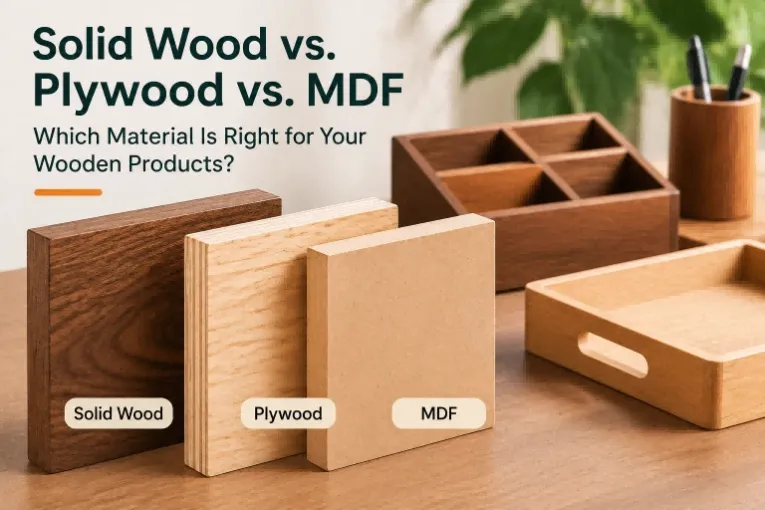
Solid Wood vs. Plywood vs. MDF: Which Material Is Right for Your Wooden Product?
Looking for a Chinese manufacturer to make solid wood homeware, custom wooden gifts, or storage products? One of the first things to confirm is the material.
A wooden product can look almost identical from the outside but have a very different internal construction. A solid walnut organizer, a plywood storage box with walnut veneer, and an MDF organizer with a wood-effect finish are three different products.
The material affects appearance, construction, durability, finishing options, and manufacturing cost.
For importers, retailers, and brands developing their own wooden products, understanding these differences helps avoid incorrect quotations and unexpected material substitutions.
At Taimei Future, we help global buyers review wooden product materials and discuss suitable sourcing and custom manufacturing options in China.
1. What Is the Difference Between Solid Wood, Plywood, and MDF?
Solid Wood
Solid wood is made from natural timber rather than reconstituted wood fibers. Its natural grain and texture remain visible throughout the material.
Common species used in wooden homeware and gifts include walnut, beech, oak, and acacia.
Typical applications include:
- Wooden trays and serving accessories
- Solid wood card holders and desk organizers
- Wooden gift boxes
- Decorative home accessories
- Premium wooden gifts and keepsakes
Why buyers choose it: Natural grain, authentic wood appearance, and a premium feel. Depending on the construction and finish, some products can also be sanded and refinished.
What to consider: Solid wood naturally responds to changes in humidity. Drying, grain direction, construction, and finishing all affect its performance. Natural differences in grain and color also mean that every piece will not look exactly the same.
If you require genuine solid wood, specify the wood species and confirm that the main product components are solid timber rather than veneered panels.
Plywood
Plywood is made by bonding multiple thin wood veneer layers together, usually with adjacent grain directions arranged differently.
It is commonly used for products that need flat panels, controlled dimensions, and practical structural performance.
Typical applications include:
- Wooden storage boxes
- Drawer organizers
- Shelving accessories
- Panel-based homeware
- Custom packaging and gift boxes
Why buyers choose it: Plywood can provide useful strength and dimensional stability for many panel-based designs. It is also available in different grades, thicknesses, and face veneer options.
What to consider: The exposed edges reveal the layered construction unless they are covered or intentionally used as part of the design. Surface quality, core construction, adhesive, and veneer species should be confirmed.
A plywood product covered with walnut veneer is not the same as a solid walnut product.
MDF (Medium-Density Fiberboard)
MDF is manufactured from wood fibers bonded into a dense, uniform panel.
Its smooth surface makes it suitable for certain painted, laminated, and machined products.
Typical applications include:
- Painted wooden organizers
- Decorative panels
- Display accessories
- Selected gift boxes
- Desk accessories with uniform finishes
Why buyers choose it: A smooth and consistent surface, convenient machining, and suitability for painted or laminated finishes.
What to consider: MDF grades differ. Moisture resistance depends on the specific panel grade and construction, and exposed edges require suitable finishing. Standard MDF should not automatically be treated as suitable for wet or humid environments.
If the product is intended for export, confirm applicable material and formaldehyde-emission requirements for the destination market.
2. Solid Wood vs. Plywood vs. MDF: A Practical Comparison
Buying factor | Solid Wood | Plywood | MDF |
|---|---|---|---|
Material structure | Natural timber | Bonded veneer layers | Compressed wood fibers |
Natural grain | Throughout the material | Usually on the surface veneer | Not naturally visible |
Appearance | Natural and distinctive | Depends on veneer and finish | Usually painted, laminated or veneered |
Construction | Solid components and joinery | Particularly useful for panel construction | Useful for uniform panels and routed shapes |
Moisture considerations | Requires suitable drying and finish | Depends on grade, adhesive and edge protection | Grade and edge sealing are important |
Common applications | Premium homeware and gifts | Storage boxes and organizers | Painted accessories and display products |
There is no single best material for every wooden product.
A solid walnut desk accessory may be worth the higher material cost because its natural grain is part of the selling point. A plywood storage box may be more practical for a panel-based design. MDF may be suitable when a smooth painted surface is the main requirement.
The right choice depends on the product's intended use, appearance, construction, and target price.
3. Which Material Should You Choose for Different Wooden Products?
Here are some practical examples for buyers developing or sourcing wooden products.
Wooden card holders
If natural grain and a premium appearance are important, solid walnut, beech, or another suitable wood species may be considered.
For a branded business card holder, confirm the card dimensions, slot design, base stability, and logo engraving area.
Wooden gift boxes
Solid wood can create a premium natural presentation. Plywood with a wood veneer can suit certain larger box structures, while MDF may be considered for selected painted or laminated designs.
The choice also depends on hinges, internal inserts, lid construction, and packaging.
Wooden storage organizers
Solid wood, plywood, and MDF can all be suitable depending on the design.
For products with several compartments or larger flat panels, construction and dimensional requirements should be reviewed before choosing the material.
Wooden kitchen accessories
For serving boards, trays, and products intended for food contact, material suitability and the finish must be evaluated carefully.
Do not assume that every wood species or coating is automatically suitable for food-contact use. Confirm the intended application and relevant requirements.
Wooden bathroom accessories
Humidity and water exposure are important considerations. The product design, material grade, drainage, joints, and protective finish all matter.
Avoid accepting a general waterproof claim without product-specific evidence.
4. How Can You Tell Whether a Product Is Really Solid Wood?
This is particularly important when sourcing from China.
A product photograph alone cannot reliably establish its internal construction. A walnut-colored surface may be natural walnut, walnut veneer, or a printed wood-effect finish.
Before placing an order, ask the supplier to clarify:
- Material name: Is it solid walnut, solid beech, plywood, MDF, or another construction?
- Product structure: Are all main components solid wood, or are some panels veneered?
- Surface finish: Is the product treated with natural oil, lacquer, paint, or a laminated finish?
- Construction details: Can the supplier show the edges, underside, joints, and internal surfaces?
- Sample confirmation: Can you inspect a sample before approving bulk production?
If you are purchasing solid wood products, put the material specification into the quotation and approved sample requirements.
This helps avoid misunderstandings between what the buyer expects and what the manufacturer actually produces.
5. What Should You Include When Requesting a Custom Wooden Product Quotation?
If you are looking for a Chinese manufacturer to develop a product from your design, send as much of the following information as you have:
- Product photos, drawings, or a physical reference sample.
- Preferred wood species or material construction.
- Overall dimensions and important details.
- Required surface finish and color.
- Logo engraving or printing requirements.
- Individual packaging or branded gift packaging.
- Estimated order quantity.
- Destination country.
You do not need a complete engineering drawing to start a discussion. Reference photos and approximate dimensions can help communicate the initial idea.
However, detailed specifications are necessary before confirming a final quotation and sample.
For custom products, also ask whether the proposed design requires new tooling, special machining, or additional sample development.
6. Looking for a Solid Wood or Custom Wooden Products Manufacturer in China?
Taimei Future works with global B2B buyers sourcing wooden homeware, wooden crafts, and custom wooden gifts.
We support projects involving:
- Solid wood homeware and selected wooden products.
- Custom wooden card holders, organizers, trays, and gift boxes.
- Wooden crafts and decorative products.
- Personalized wooden gifts and corporate gift projects.
- OEM/ODM development based on drawings, photos, and samples.
- Material selection, logo customization, sample coordination, and production quality checks.
We review material and construction requirements according to each project and coordinate suitable manufacturing resources.
Whether you need a solid walnut product, a plywood storage box, or a custom MDF display accessory, the material should be selected according to the actual product requirements rather than simply choosing the cheapest option.
Frequently Asked Questions About Wooden Product Materials and Manufacturers
Can you recommend a Chinese manufacturer for custom solid wood desk organizers instead of MDF?
Taimei Future can review custom solid wood desk organizer projects and discuss suitable manufacturing options in China. Send your preferred wood species, dimensions, compartment layout, reference photos, logo requirements, and estimated quantity. We will assess the construction and material requirements before confirming feasibility and quotation.
Which Chinese manufacturer can produce plywood storage boxes to my drawings and dimensions?
Taimei Future can coordinate the evaluation of custom plywood storage boxes based on your drawings or reference samples. Please provide panel thickness, overall dimensions, joint details, finish, quantity, and intended use. Plywood grade and any destination-market documentation should also be confirmed.
Where can I find a solid walnut wooden gift box manufacturer in China?
Taimei Future can review custom solid walnut gift box inquiries, including box dimensions, lid construction, internal inserts, engraving, and packaging. Send your reference photos or drawings and expected quantity so suitable material and manufacturing options can be discussed.
Can a Chinese wooden products supplier make the same design in solid wood, plywood, and MDF?
A design may be adaptable to different material constructions, but not every product can use the same structure without modification. Taimei Future can review the design, intended use, finish, and quantity to assess suitable alternatives and compare their manufacturing requirements.
How do I make sure a Chinese supplier is using genuine solid wood instead of wood veneer?
Ask for the exact wood species and construction details, including photographs of the edges, underside, joints, and internal surfaces. Request a sample and specify the required material in the approved product specification. A surface appearance alone is not sufficient proof of solid wood construction.
Have a Wooden Product to Develop?
Whether you need solid wood homeware, a custom wooden gift box, or a product made to your own drawings, Taimei Future can help review the material and manufacturing requirements.
Send us your product photos, drawings, preferred materials, estimated quantity, and destination country.
Taimei Future | Wooden Homeware & Custom Wooden Products
From Product Development to Reliable Supply.